Guides / October 23, 2026
Your January 2027 Deliveries May Carry the Wrong DFARS Clause
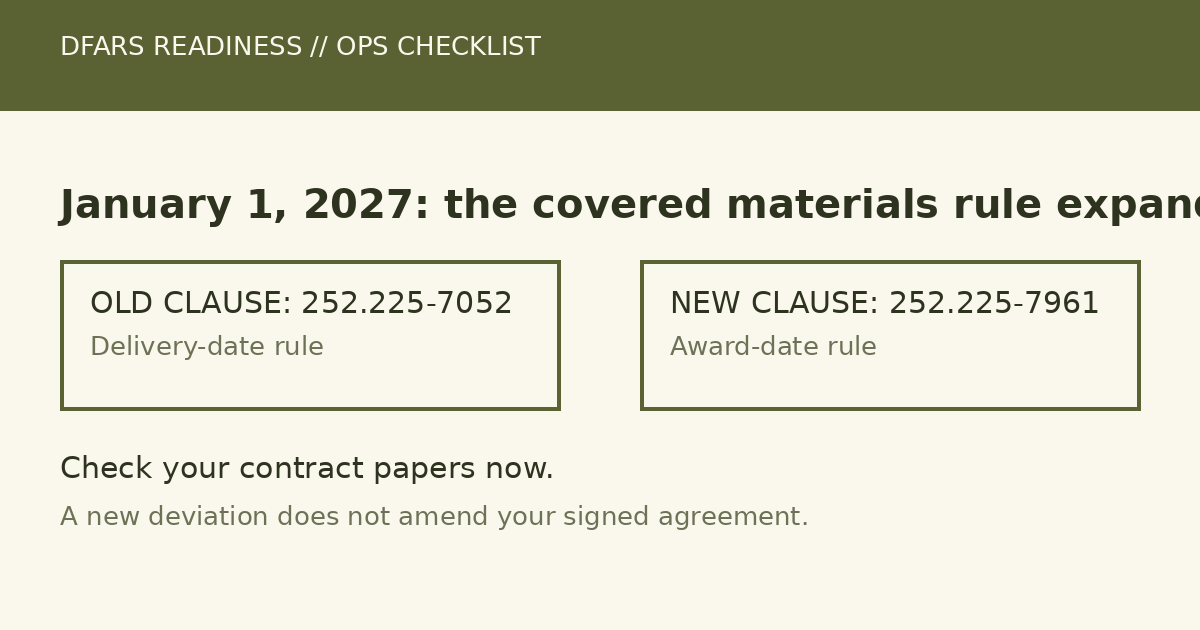
Material sitting in your warehouse today can still fail a delivery in January. The clause in your contract decides, not the date you bought the metal.
On October 21, 2026, Pillsbury published an alert for defense contractors. The warning centers on a date: January 1, 2027. On that date, DFARS (Defense Federal Acquisition Regulation Supplement) clause 252.225-7052 expands by its own terms.
The clause name is "Restriction on the Acquisition of Certain Magnets, Tantalum, and Tungsten." Its May 2024 version uses a delivery-date rule. Anything you deliver under it must satisfy the clause as it reads on the delivery date.
Through December 31, 2026, the clause bars delivery of covered material melted or produced in a covered country. Covered countries are China, Russia, North Korea, and Iran. It also bars end items made in a covered country that contain covered material. On January 1, 2027, the clause adds three stages: mining, refining, and separation.
A magnet refined in a covered country in 2024 can still ship in December 2026. The same magnet may fail a January 2027 delivery. The purchase date gives you no safe harbor.
The newer clause that helps
Congress rewrote the timing rule. Section 848 of the fiscal 2026 defense authorization act revised the statute behind the clause. The expanded restriction now applies to contracts awarded on or after January 1, 2027, not to deliveries.
Revision 1 to class deviation 2026-O0041 implements that award-based rule. It created DFARS clause 252.225-7961, dated June 2026. Under that clause, the mining, refining, and separation restriction reaches only contracts awarded from January 1, 2027 forward.
The melting, production, and end-item rules stay in force either way. The new clause does not relax those.
The catch: nothing amends itself
The deviation is not self-executing. A new rule does not rewrite your signed contract. An existing prime contract, subcontract, or purchase order that still carries section 7052 is still governed by it.
If your agreement contains both clauses, neither one cancels the other. You need a written amendment. The cleanest version deletes section 7052 and incorporates section 7961 expressly.
Which agreements need attention
Start with agreements that call for delivery in January 2027 or shortly after. For each one, write down three facts: the clause number and date, the award date, and the delivery date.
Pre-2027 awards that already carry section 7961 are in good shape on timing. Pre-2027 awards that still carry section 7052 are the group to fix now. Agreements with both clauses need a conflict-resolving amendment.
Task and delivery orders deserve care. The instrument under which delivery occurs is what counts. A pre-2027 prime award may sit above a lower-tier purchase order awarded in 2027. Check the lower-tier paper too.
What to do this week
List every contract, subcontract, purchase order, and delivery order with a covered material delivery after December 2026. Record the clause number, clause date, and award date for each. Ask the contracting officer or customer for a written amendment where section 7052 still governs. Coordinate flowdowns with subcontractors. Keep the chain of sourcing evidence for mining, refining, separation, melting, production, and manufacture.
PolicyCortex does not manage your purchase orders. Your contracts team owns the amendments. PolicyCortex helps you keep compliance evidence organized against NIST 800-171 controls.
Sources
- Time Is Running Short to Update DFARS Covered Materials Clauses, Pillsbury Winthrop Shaw Pittman, October 21, 2026.
- DFARS Overhaul Class Deviations, DFARS Part 225 summary, Wiley Rein, confirming the January 1, 2027 start date and clause 252.225-7961.
- DFARS clause 252.225-7052 (MAY 2024) and clause 252.225-7961 (JUN 2026), cited from the clause text analyzed in the Pillsbury piece above.
Next step
Want your compliance evidence in one dated record? See how PolicyCortex maps live Azure configuration to NIST 800-171 controls.
Original diagram by PolicyCortex.