Guides / October 24, 2026
How Do I Document Safeguards Without a Big Team?
You have three people, a full contract, and a safeguard list that looks built for thirty.
DFARS means Defense Federal Acquisition Regulation Supplement. CUI means Controlled Unclassified Information. NIST means National Institute of Standards and Technology. SSP means System Security Plan. POA&M means Plan of Action and Milestones.
Start from the clause, not from a blank page
DFARS clause 252.204-7012 sets your duty in plain terms. Provide adequate security on covered contractor information systems. A covered system is one you own or operate. It stores, processes, or transmits covered defense information. The clause text is the source for this duty (DFARS 252.204-7012).
For those systems, meet the requirements in NIST SP 800-171. NIST SP 800-171 Revision 2 lists 110 requirements in 14 families. Do not start with all 110 at once. Start with the systems that hold CUI. List those systems first. Everything else follows that list.
Use one template for every requirement
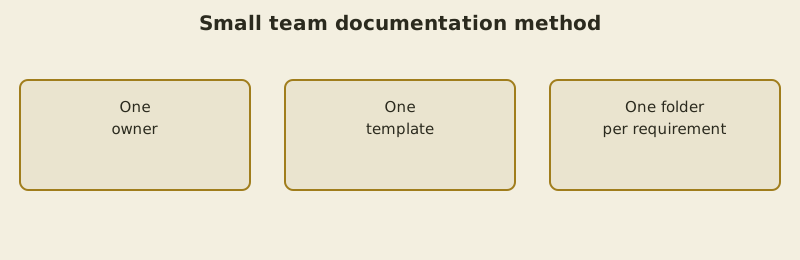
A small team cannot write 110 unique essays. Use one short template for each requirement. Keep the template to five fields.
Field one is the requirement in plain words. Field two is how you meet it. Field three is the owner. Field four is the evidence. Field five is the review date.
Write each field in one or two short sentences. A template keeps the work even. It also makes review fast. A reviewer can check any requirement in two minutes.
Name one owner per family, not per requirement
You do not need 110 owners. Name one owner per family. That gives you 14 owners at most. In a small team, one person may own several families. That is fine if the name is real.
The owner does three jobs. They run the safeguard. They collect the evidence. They update the template when anything changes. If an owner leaves, reassign the family that week. An unnamed family drifts fast.
Collect evidence as you work, not at the end
Evidence collected at the end is often missing. Evidence collected during work is usually complete. Tie each task to its record at the time you do it.
Access reviews create a dated review sheet. Backups create a dated backup log. Training creates a dated attendance list. Patching creates a dated patch record. File each record in the folder for its requirement.
Use one folder per requirement. Name the folder by requirement number. Inside, keep only the newest record and the prior record. Old files pile up fast. Two records per folder stay easy to check.
Write the SSP from the templates
Your SSP is the set of templates, joined in order. Requirement 3.12.4 in NIST SP 800-171 Revision 2 requires the SSP to describe the boundary and the environment. It must show how you meet each requirement. It must show links to other systems.
Copy each template into the SSP in requirement order. Add a short boundary section at the front. Add a short diagram of CUI flow. That is the whole SSP for a small team.
When a requirement is not met, do not hide it. Write the gap in the template. Add it to the POA&M with an owner and a date. A clear gap with a plan beats a vague claim.
Keep the routine small and steady
Review one family each week. That pace covers all 14 families in about three months. Update the template when a tool changes. Update it when a person changes. Update it when a system changes.
Small teams fail by trying to do everything at once. They succeed by doing a little each week. A steady routine also gives you dated proof. Dated proof is what an assessor asks for first.
Next step
PolicyCortex collects evidence from live Azure configuration with 33 collectors. The collectors read conditional access, diagnostic settings, Defender posture, backup, and firewall. The evidence is evaluated against NIST 800-53 and NIST 800-171. That evidence supports re-verification after remediation. SAR means Security Assessment Report. It generates SSP, SAR, and POA&M output from collected evidence. AWS means Amazon Web Services. PolicyCortex is strongest in commercial Azure, and AWS is covered. Start at policycortex.com.
Sources
- DFARS 252.204-7012, Safeguarding Covered Defense Information and Cyber Incident Reporting. https://www.acquisition.gov/dfars/252.204-7012-safeguarding-covered-defense-information-and-cyber-incident-reporting
- NIST SP 800-171 Revision 2, Protecting Controlled Unclassified Information in Nonfederal Systems and Organizations. https://doi.org/10.6028/NIST.SP.800-171r2
- NIST SP 800-171A Revision 2, Assessing Security Requirements for Controlled Unclassified Information. https://doi.org/10.6028/NIST.SP.800-171a
- Diagram: original by blog.dfarsreadiness.com.