Guides / November 04, 2026
How Do I Respond to a Prime Contractor's DFARS Flow Down Questionnaire?
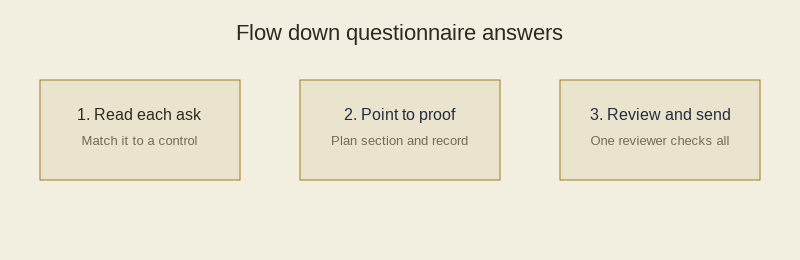
A prime contractor sends a long questionnaire, and your team is not sure what counts as an answer. Vague answers invite follow up questions and delays. The fix is to answer each question with a plan section and a dated record.
Defense Federal Acquisition Regulation Supplement (DFARS) clause 252.204-7012 sets safeguarding rules for covered defense information. Primes must pass those rules down to subcontractors that handle such information. The questionnaire is how the prime checks that you can meet them.
Read the whole questionnaire first
Read every question before you answer any of them. Mark each question as one of three types. Some ask what safeguard you have. Some ask for a record that proves it. Some ask about a gap and your plan to close it.
Note the due date and the contact for questions. Ask the prime early if a question is unclear. A clear question gets a clear answer, and a guessed answer gets challenged later.
Answer each question in the same shape
Use one shape for every answer. First, state the safeguard in one sentence. Second, name the section of your system security plan that describes it. Third, name the record that proves it, with its date.
A system security plan is the written plan that describes how you protect covered defense information. Point to its section number, not just its title. Section numbers let the prime find the text fast.
For a question about access control, name the access rule and a recent access review. For a question about incident reporting, name the reporting steps and a drill record. For a question about training, name the training course and the completion list.
Handle gaps and not applicable items honestly
If a safeguard is not yet in place, say so plainly. State what is missing, who owns the fix, and the due date. Add the plan entry that tracks the fix. A dated plan beats a vague promise every time.
If a question does not apply to your work, say why in one sentence. State what you do not handle, and what keeps it out of scope. Do not claim a safeguard you do not have. A false claim in a questionnaire can cause more harm than a gap.
Have one reviewer check all answers before you send them. The reviewer checks that each answer matches the plan. The reviewer checks that each record date is real. The reviewer checks that no answer claims more than the record shows.
Keep a copy of the sent questionnaire and your answers. Log any follow up questions from the prime. Answer follow ups in the same shape, with new dates on new records.
What to do this week
Map each questionnaire question to a plan section. Gather one dated record per question. Draft the gap answers with owners and due dates. Send the reviewed set before the due date.
Sources
- DFARS 252.204-7012, Safeguarding Covered Defense Information, Acquisition.gov.
- NIST SP 800-171 Revision 2, National Institute of Standards and Technology.
- Original diagram by PolicyCortex.
Next step
Want DFARS proof tied to each requirement? See how PolicyCortex collects it from live systems.