Guides / October 29, 2026
How Do I Score Partial Implementation of a Requirement in My Self-Assessment?
You implemented most of a requirement, but not all of it, and the score is unclear.
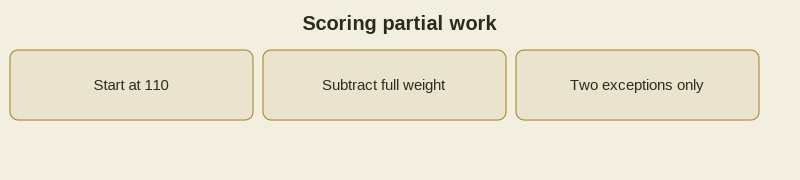
DFARS means Defense Federal Acquisition Regulation Supplement. SPRS means Supplier Performance Risk System. NIST SP 800-171 sets out 110 security requirements. The DoD Assessment Methodology turns your self-assessment into one SPRS score. Start at 110. Subtract points for each requirement that is not fully met.
The main rule: no partial credit
For most requirements, partial work counts as not met. A control that covers half your systems is not met. A control that runs but has no dated proof is not met. A control that works for most users is not met. You subtract the full weight for that requirement.
Each requirement carries a weight of 5, 3, or 1. The weight reflects the risk if that requirement is missing. A 5 point requirement missing costs 5 points. A 3 point requirement missing costs 3 points. A 1 point requirement missing costs 1 point. The weights are set in the methodology. You do not choose them yourself.
Scores can fall below zero. The lowest possible score is negative 203. That happens when many high weight requirements are missing. A low score is honest if it matches your evidence. An inflated score is worse than a low one. It will not survive a review.
The two exceptions with a set rule
Two requirements allow a smaller deduction for partial work. The first is multifactor authentication, requirement 3.5.3. MFA means multifactor authentication. If MFA is missing, subtract 5. If MFA covers remote access and privileged accounts, but not all users, subtract 3.
The second is FIPS-validated cryptography, requirement 3.13.11. FIPS means Federal Information Processing Standards. If CUI is not encrypted at all, subtract 5. CUI means Controlled Unclassified Information. If CUI is encrypted, but the module is not FIPS-validated, subtract 3.
No other requirement has this middle step. Do not invent one for a requirement you like. Do not carry a middle step from one requirement to another.
How to score one requirement, step by step
First, read the requirement and its assessment objectives in NIST SP 800-171A. Each objective states one checkable fact. Second, gather proof for each objective. A policy alone proves nothing without a dated record. Third, mark the requirement met only if every objective has proof. If even one objective lacks proof, mark it not met and subtract the full weight.
Fourth, write down why you marked it that way. Name the proof you used. Name the gap that remains. Fifth, add a POA&M entry for the gap. POA&M means Plan of Action and Milestones. Give the gap an owner and a due date. Your score, your proof, and your POA&M should agree.
A worked example
Say you meet 100 requirements fully. Ten requirements are not met. Eight of those carry a weight of 1. Two carry a weight of 3. Subtract 8, then subtract 6. Your score is 96. That math is simple. The hard part is the honest marking step before it.
Now say one of the ten is MFA, requirement 3.5.3. MFA covers remote access and privileged accounts, but not all users. Subtract 3 for that requirement, not 5. That is the exception at work. Every other partial requirement in the example still takes its full weight.
What to file with your score
Keep the scoring sheet, the proof for each requirement, and the POA&M together. A reviewer should trace each deduction to a gap. A reviewer should trace each met mark to proof. If a mark has no proof behind it, change the mark before you post the score. Posting an honest score on time beats posting a high score you cannot defend.
Sources
- NIST SP 800-171 DoD Assessment Methodology, Version 1.2.1.
- DFARS 252.204-7019.
- DFARS 252.204-7020.
- NIST SP 800-171A.
- Original diagram by PolicyCortex.
Next step
Want evidence tied to each requirement from live systems? See how PolicyCortex collects it.