Guides / October 25, 2026
Where Should a Small Contractor Spend First on DFARS?
Your budget is small and your DFARS list is long. Spend first where a breach would hurt most, and leave the rest for later.
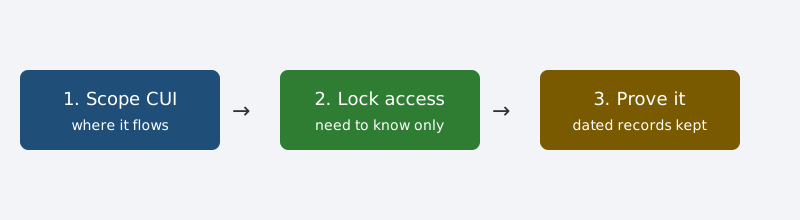
DFARS means Defense Federal Acquisition Regulation Supplement. CUI means Controlled Unclassified Information. SSP means System Security Plan. POA&M means Plan of Action and Milestones. NIST means National Institute of Standards and Technology.
Start where CUI lives
DFARS clause 252.204-7012 requires adequate security for covered defense information. NIST SP 800-171 Revision 2 defines what adequate means in practice. Find every place CUI can flow before you buy anything. Map the systems, the folders, and the people who touch them. Anything outside that map gets no budget yet.
Spend in this order
First, lock access to CUI systems. Second, give access only to staff who need it for the work. Third, turn on multifactor authentication for remote access. Fourth, turn on logging so you can see who touched CUI. Fifth, write the SSP from what you actually built. Sixth, back up CUI systems and test the restore.
What to delay
- New dashboards before basic access control is done
- Tools that cover systems with no CUI in them
- Policies no one has read or tested
Prove it as you go
Keep one proof record for each safeguard you build. A dated access list beats a promise in a meeting. Score yourself honestly against each requirement. Put gaps in a POA&M with dates and owners. That honest record is what a prime contractor wants to see.
Sources
- DFARS clause 252.204-7012, Safeguarding Covered Defense Information.
- NIST SP 800-171 Revision 2.
- Original diagram by PolicyCortex.
Next step
Want safeguards tracked against live configuration? See how PolicyCortex checks them.